LCA 1: THE IMPORTANCE OF LIFE CYCLE ASSESSMENT
Published on Építészfórum on 2 April 2025 (in Hungarian)
Buildings don’t just emit carbon dioxide during their operation – their construction alone has a significant carbon footprint. In order to urgently decarbonise our built environment, it is essential to have a comprehensive picture of the emissions generated over the lifetime of a building. Life Cycle Assessment (LCA) can help, but its practical application can raise a number of issues and it is also challenging to keep track of changes in the national and EU regulatory environment. In the first part of this series, we look at the basics of LCA and recent changes in the regulatory environment to help move our buildings and cities towards sustainability.
The environmental impact of buildings
Not so long ago, our buildings were made from natural, biodegradable materials such as wood, clay, straw and stone. These resources require minimal processing and have a low carbon footprint. But today, with industrialisation and changing building needs, materials that are energy-intensive to produce, process and decompose have become inevitable. One such material is concrete, whose main component, cement, requires so much energy to produce at high temperatures that it alone is responsible for around 8% of global CO2 emissions[i].
According to a study by the World Green Building Council (WBGC), buildings are responsible for 39% of the annual greenhouse gas emissions associated with global energy use[ii]. 11% of these emissions are embodied carbon, which is linked to building materials and construction processes, while the remaining 28% are operational carbon, which comes from the operation of the building over decades (e.g. from heating, cooling and electricity use)[iii].
As our buildings become more energy efficient and their electricity supply is shifting to renewable sources, their operational carbon footprint will also be significantly reduced[iv]. While calculating the operational energy consumption of buildings has been a requirement for licensing and occupancy for almost twenty years now, in order to reduce the installed carbon footprint, we must first learn to quantify it.
For more than 10 years, the experts at ABUD – Advanced Building & Urban Design have been carrying out life cycle assessments to assess the environmental footprint of buildings and, among other things, to achieve the highest levels of green building certification, such as BREEAM Excellent and LEED Platinum. The use of LCA has contributed to reducing environmental impacts in many cases.
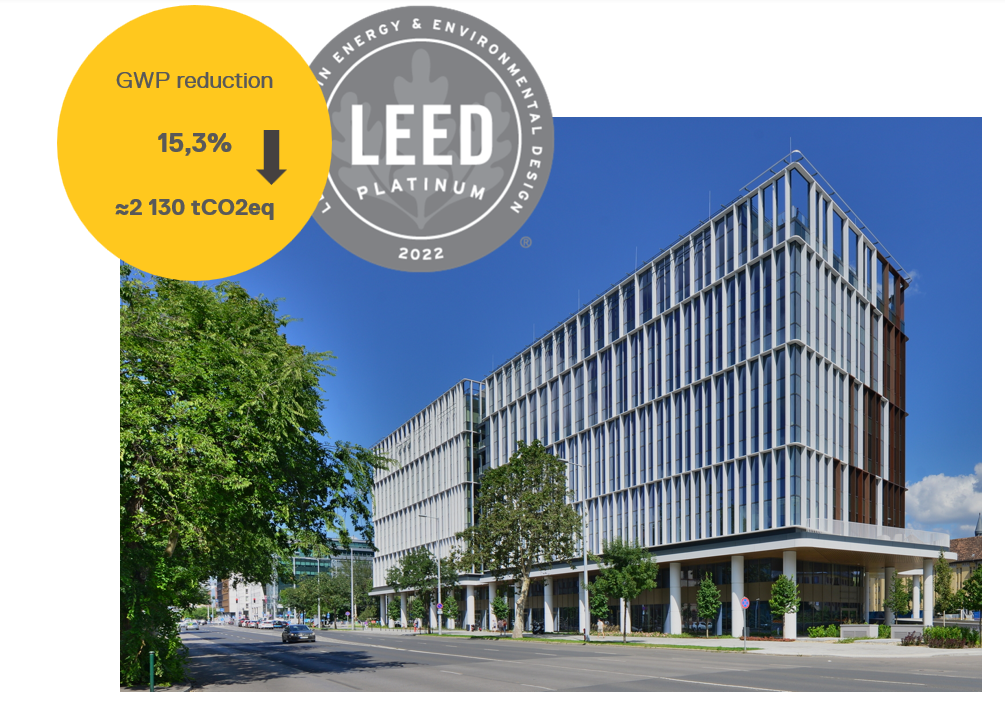
Results of the LCA calculation for the LEED MRc Building life-cycle impact reduction credit – H2Offices – Phase 1. Source © Skanska
Nowadays, life-cycle thinking is also becoming more and more important in domestic legislation, so it is becoming crucial for the construction industry to understand it. Not surprisingly, the EU’s Energy Performance of Buildings Directive (EPBD) [v] requires that from 2028 onwards, life-cycle analysis will be mandatory as a complement to energy certification in the design of a building.
Basics of Life Cycle Assessment
Life Cycle Assessment (LCA) is a standardised, scientific method for measuring and evaluating the environmental impacts of buildings and raw materials (or products and services) throughout their life cycle. According to LCA, a building has a significant environmental impact from the moment it is constructed (or when materials are procured) and can be expected to have significant carbon emissions even after it is demolished. Indeed, LCA analyses quantify emissions from resource extraction, materials production, transport, construction, operational energy and water use, maintenance, refurbishment and final demolition.
The Whole Life Cycle Carbon Assessment (WLCA), also known as cradle-to-grave LCA, takes into account each stage of the life cycle of a building, from cradle to grave: from the raw material extraction, through the production and processing of building materials (from the point of exit from the factory, the “gate”), and the operation of the building, to the waste management (the “grave”)[vi]. There are cradle-to-gate and cradle-to-cradle LCAs, which are different scopes of assessment.
Life Cycle Assessment (LCA) records a number of environmental impacts, such as Ozone Depletion Potential (ODP), eutrophication (excessive enrichment of water with phosphorus and nitrogen, leading to water quality degradation)[vii] and Global Warming Potential (GWP), the most commonly used metric in the construction industry. In this framework, embodied carbon refers to the global warming potential of building materials and energy used in construction, while operational carbon refers to the emissions of energy used in the use of a building[viii].
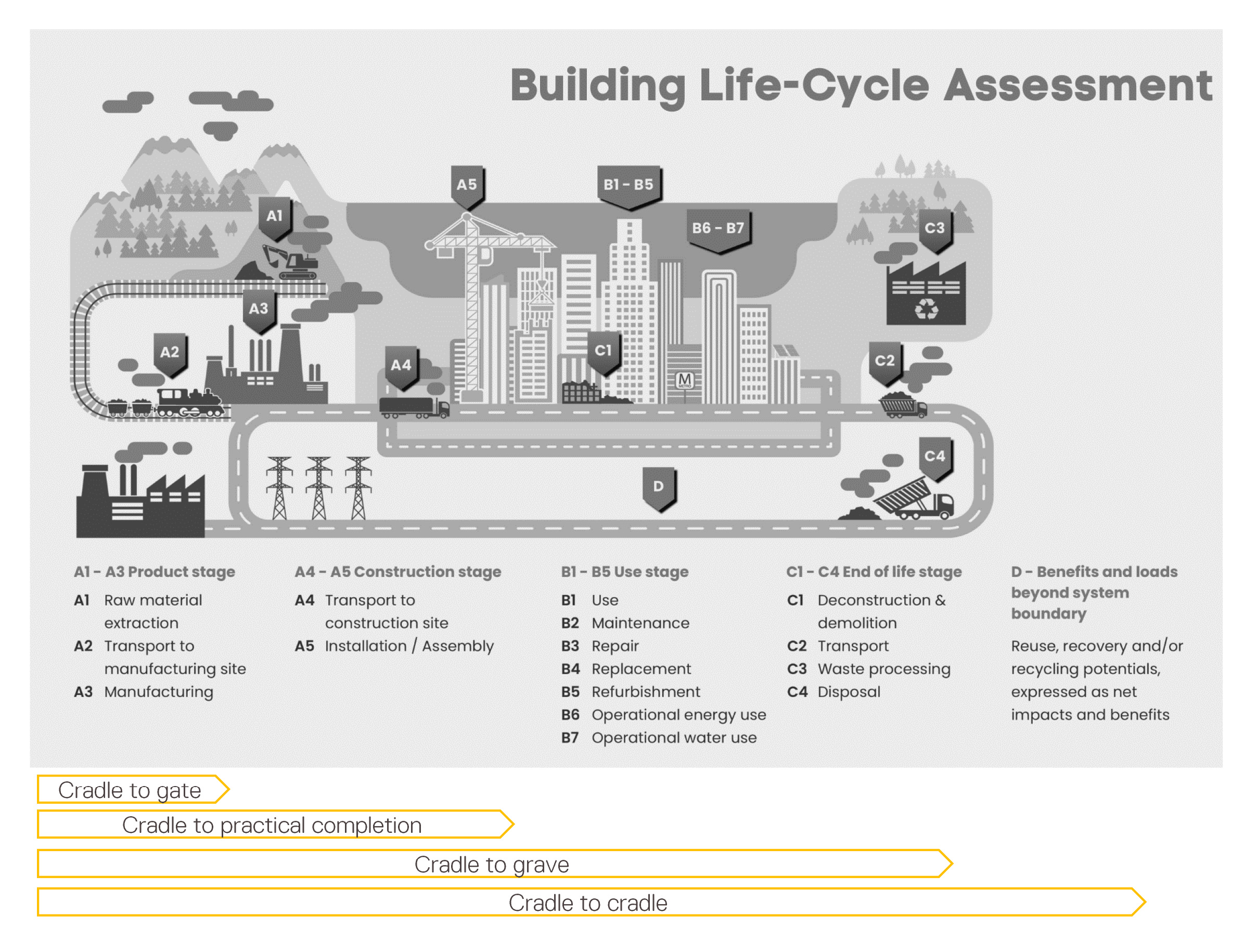
Stages in the life cycle of a building according to EN 15978 and EN 15804. Source © OneClick, translated and edited by ABUD
LCA in four steps: methodological overview
Due to regional variations and advances in research and development on building materials, the methodology of life cycle analysis is also constantly changing. ISO 14040 and ISO 14044 standardisation efforts ensure the reliability and consistency of LCA[ix].
In practice, life cycle analysis at the building scale consists of four phases. Firstly, the objectives and scope of the analysis must be defined, including the systems to be analysed and the life cycle, which is typically set at 50-60 years, focusing on building materials. Then, the data collection phase involves collecting input data on material quantities, construction processes, transport and operational energy use. Environmental Product Declarations (EPDs) are used as a basis for the assessment of environmental impacts and LCA tools are applied. In the fourth and final phase, the results are interpreted in accordance with the original purpose of the study. This may be to compare the results with regional benchmarks, to help decision making on design issues or to obtain a green building certification.

The four steps of LCA according to ISO 14040 and 14044. Source © root-sustainability.com, edited by ABUD
Building structures = 60% of emissions
Life cycle analysis also provides guidance when constructing new buildings or renovating existing ones.
“…there is a quest for an optimum that involves deep analysis. It is necessary to assess whether or not the demolition of a building is worthwhile in terms of its entire life cycle, whether in terms of energy or materials.” – said Dr András Reith, CEO of ABUD, in an interview with Építészfórum (one of the leading Hungarian online architectural platforms) 15 years ago[x].
Based on a comparison of our LCA calculations on 8 newly built domestic office buildings, 1 commercial and 1 industrial property over the last ten years, we found that more than 60% of the total life cycle emissions of buildings come from the structural elements (see Figure 4).
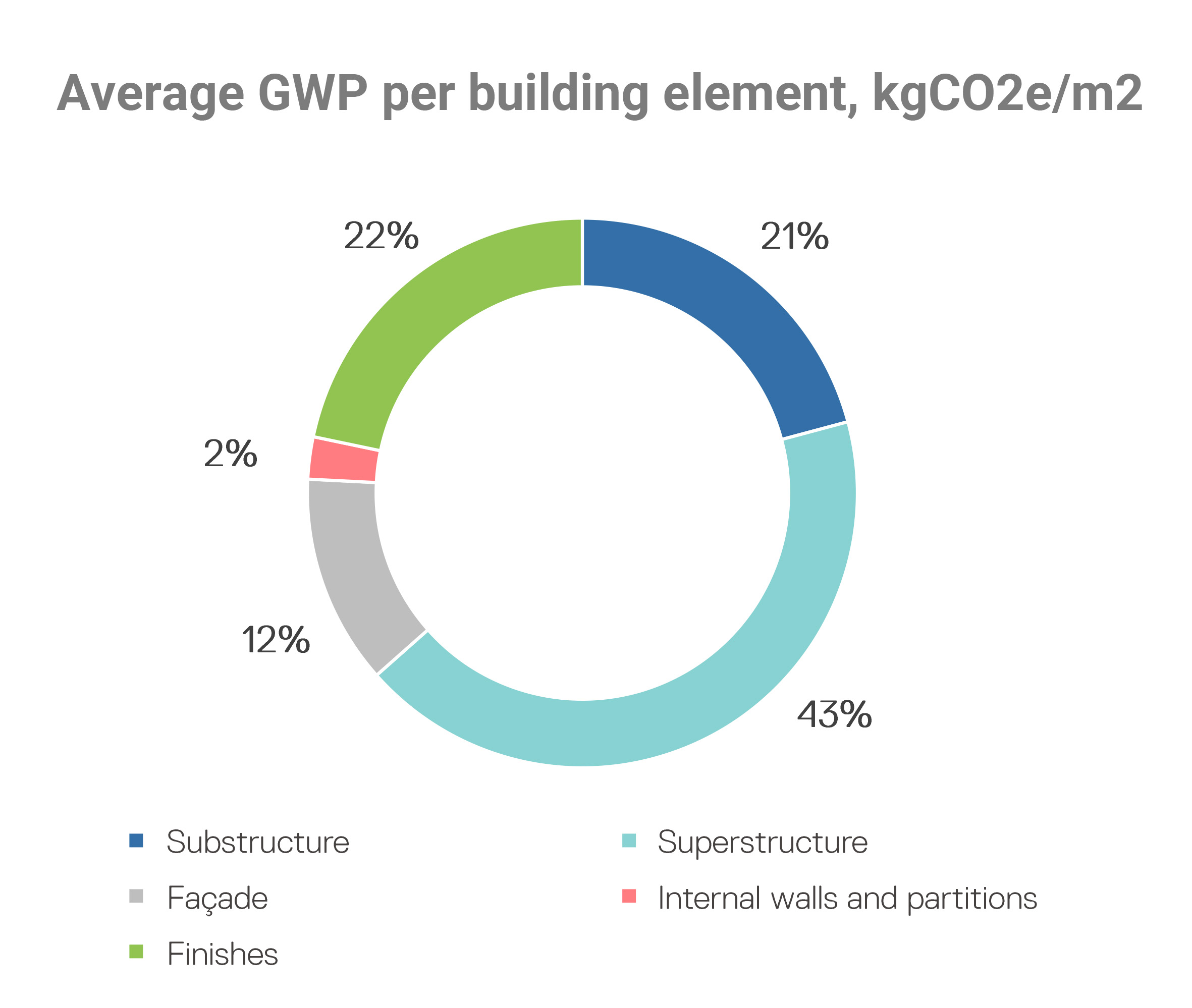
Global warming potential (GWP) rates by building element for new buildings: based on 8 office, 1 commercial and 1 industrial buildings. Source © ABUD
In the light of the above, the opportunity to renovate becomes significantly more valuable, as we can reduce the amount of carbon installed by reusing existing structures. If we do decide to build a new building, it is crucial to recycle as much of the existing structures as possible and to prioritise future changes of function, ensuring that the structures can be reused and their lifetime extended.
Monitoring emissions: regulatory pressure
Governments and regulatory bodies are increasingly focusing on the use of life cycle assessment (LCA) and the assessment of the environmental impact of building stock. According to global decarbonisation scenarios, the building sector needs to reduce its installed carbon by 40% by 2030 to reach net zero emissions by mid-century, in line with the Paris Climate Agreement targets[xi].
The EPBD (Energy Performance of Buildings Directive) of the European Parliament and of the European Council 2024/1275[xii] requires life-cycle assessments for new buildings with a useful floor area of more than 1 000 m2 from 2028 and for all new buildings from 1 January 2030. This should be implemented into national practice in the coming years.
In Europe, the number of national regulations and voluntary certification schemes based on life-cycle carbon emissions is growing rapidly[xiii] and already includes directives for EU Member States, as well as supranational regulations and voluntary certification schemes that promote sustainable building practices. Many EU Member States have developed their own methodologies or databases for measuring carbon emissions to ensure compliance with international standards.
LCA is also becoming more and more prominent in the relevant legislation in Hungary, and domestic policy is also pushing for the use of standardised life cycle analysis in the construction industry. The Hungarian Act C of 2023 on Architecture (Act on Architecture)[xiv] introduced the concept of the “Green Card – Green Passport”. According to the law, building energy performance certificates should be supplemented with a so-called green card, which would carry additional information on the built green environment of the building, including the possible green utility supply. This document would be part of the development of a green passport system, which could track the complex system approach of “green energy, green environment and green-conscious use” throughout the life cycle of buildings.
According to Méptv., a building or part of a building must be designed, constructed and used in such a way that it has an energy certificate, a green passport and a life-cycle service book before it is put to its intended use. The implementing government decree that elaborates the details has not yet been published, but the TEKA[xv], which is applicable from 01.01.2025 (applicable from 01.07.2025 for construction activities), already requires that sustainability aspects, including life cycle assessment, be taken into account in the design, implementation and demolition of the building and its components.
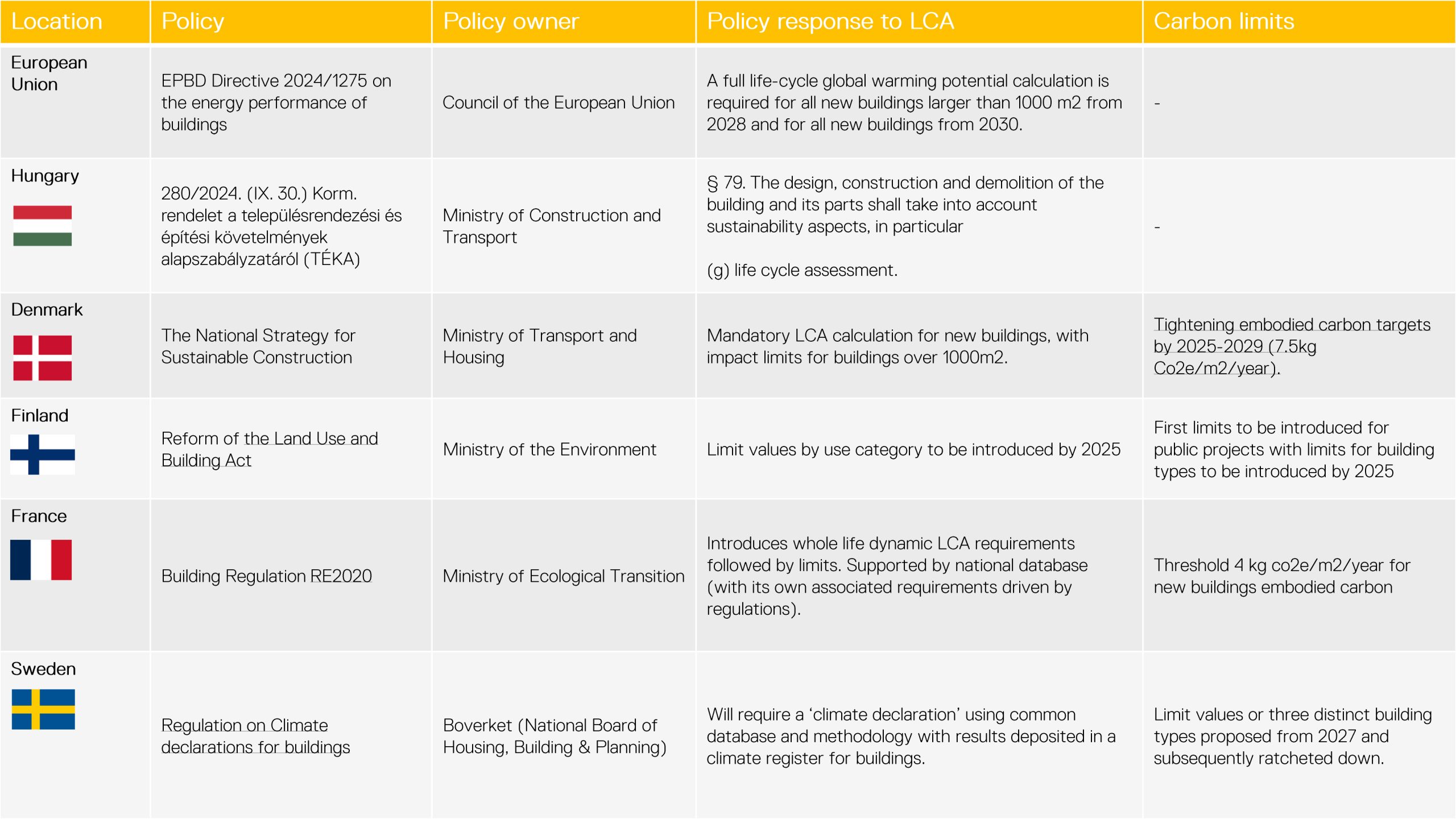
Life Cycle Assessment obligations in EU countries. Source © ABUD
EU Taxonomy and green building certification – catalysts for LCA
In addition to regulatory requirements, two key factors influence the widespread uptake of LCA: market demand and financial incentives. Developers and investors are also increasingly demanding transparency on the full environmental impact of buildings. LCA also helps companies to obtain green building certification, improving resource efficiency and increasing competitiveness in a market that is moving towards sustainable construction.
International green building certification schemes such as LEED, BREEAM and DGNB have recognised the importance of conducting life cycle assessments. Recently, the criteria for certification have also been modified to award more points for meeting more stringent requirements. LEED v4.1, for example, requires an LCA analysis that requires a reduction in global warming potential (GWP) of up to 40% from baseline. Changes to BREEAM are also expected this year. Under the forthcoming V7 system, it will no longer be sufficient to calculate compliance, but will also be necessary to meet minimum values for scoring.
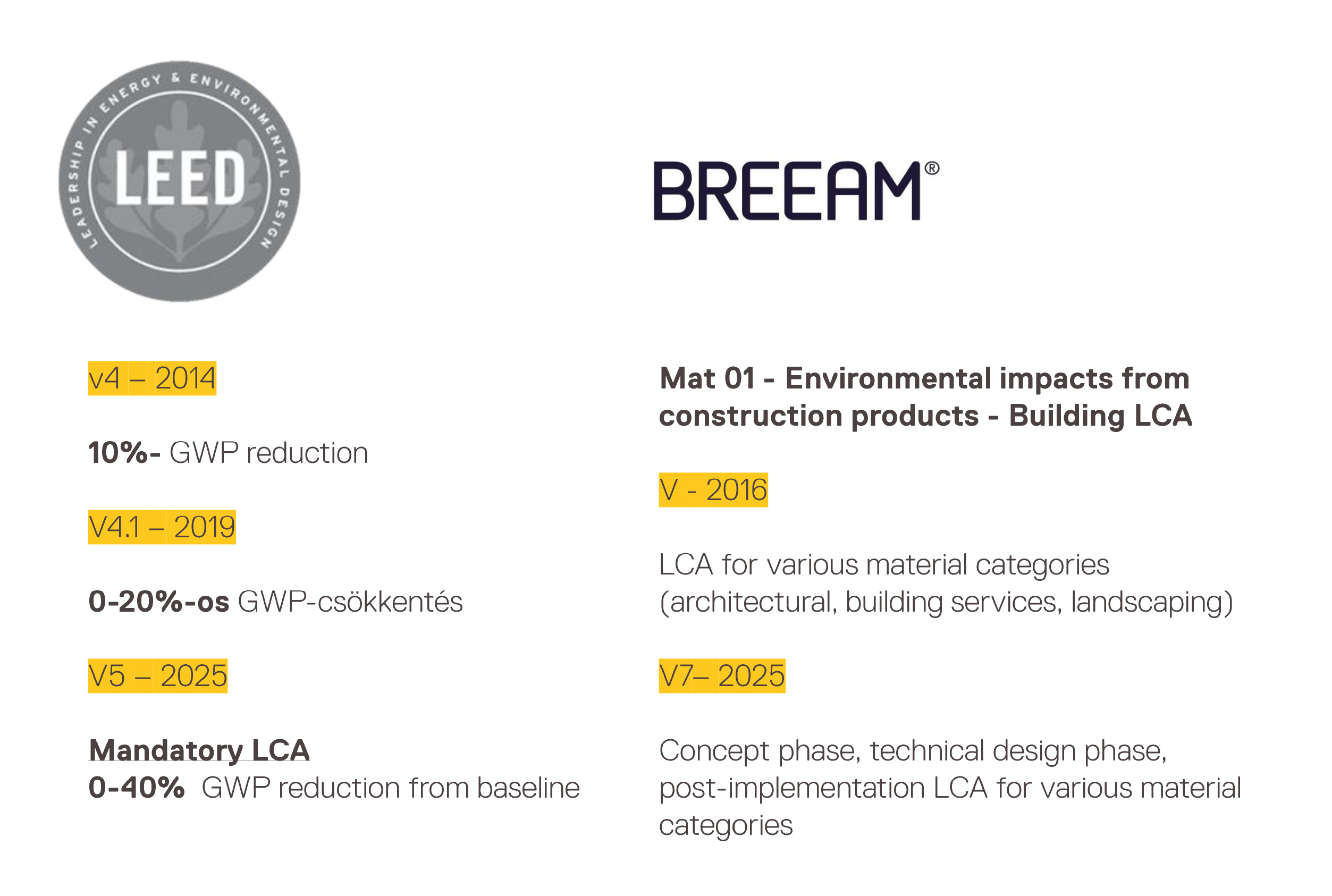
Changes to LEED and BREEAM LCA criteria. Source © ABUD
In addition, the EU Taxonomy[xvi] sets clear sustainability criteria for the construction industry and requires LCA-based reporting for new buildings larger than 5 000 m2. Compliance with these voluntary requirements is essential for obtaining green financing and implementing ESG-based investment strategies.
A Whole Life Cycle Carbon Assessment (WLCA) helps to quantify installed emissions, including so-called Scope 3 indirect emissions. This concept, introduced in 2001, is derived from the Greenhouse Gas Protocol (GHG Protocol) framework and is a category of greenhouse gas emissions that companies include in their ESG (Environmental, Social, Governance) reports[xvii]. Scope 3 emissions include other indirect emissions that are not directly verifiable and occur along the value chain from suppliers to end-users. Examples include emissions related to materials production, transport, construction, waste and operational energy use, which are increasingly becoming a core requirement of corporate environmental policy.
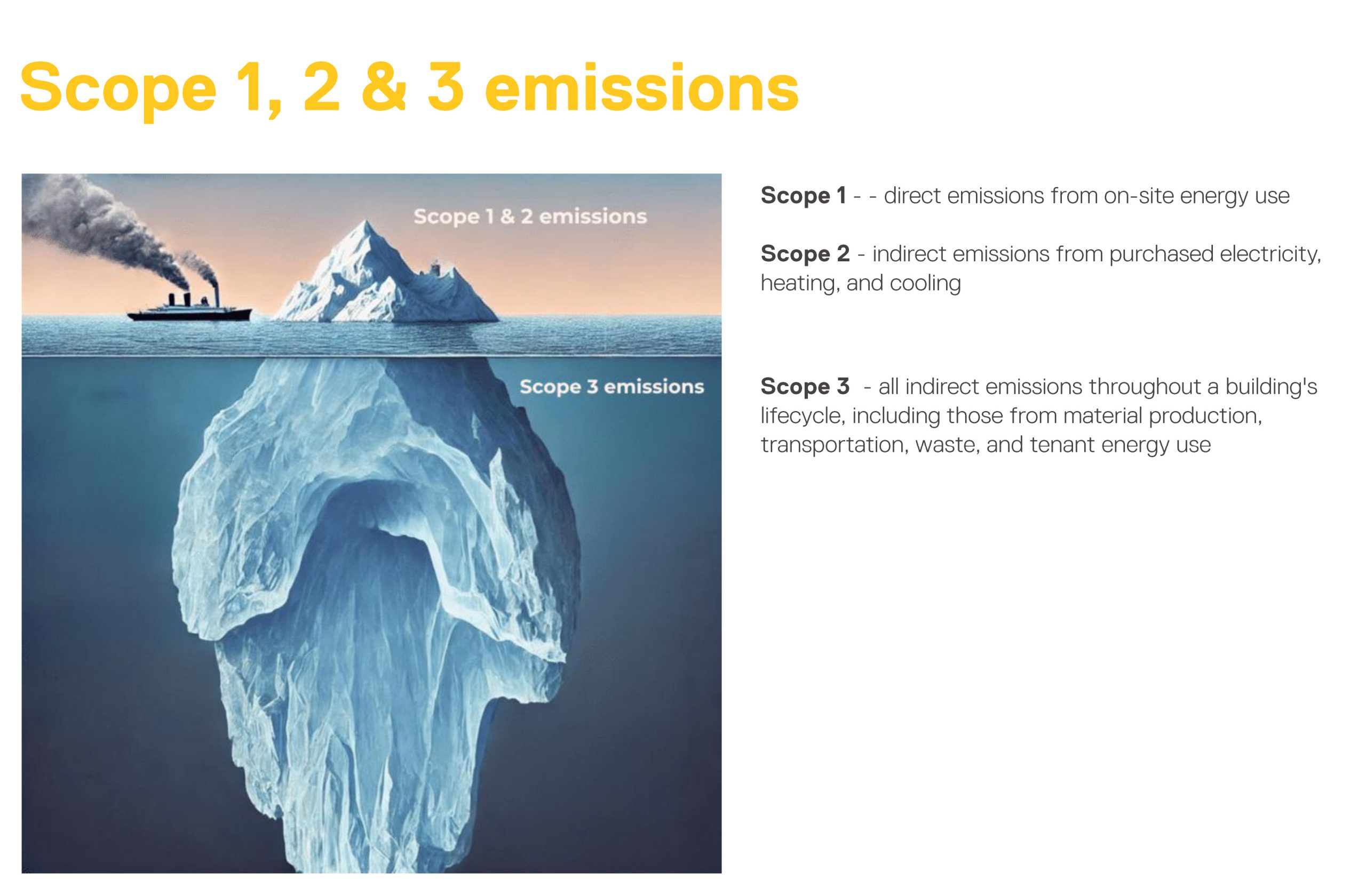
Scope 1, 2 and 3 emissions. Source © root-sustainability.com, edited by ABUD
Summary
Life cycle analysis has become a key tool for reducing environmental impacts and optimising resource use, and its application is required by national and international legislation. As architects, property developers or investors, we have a huge responsibility to the environment and to minimise our carbon footprint. LCA can quantify the actual life cycle environmental impact of a building material or solution, helping to select more efficient, greener and, not least, more cost-effective solutions.
In the second and third part of this series, we will look at the practical application of LCA, with a particular focus on the different phases of building design, construction, operational carbon footprint and end-of-life. In the fourth part of the series, we will look at LCA at product level.
Authors
Sofia Rostilova
Junior Consultant, ABUD – Advanced Building & Urban Design
Melinda Orova
Senior Consultant, ABUD – Advanced Building & Urban Design
Master of Architecture (BME)
Master of Urban and Facility Energy (PTE)
LEED Accredited Professional BD+C
Dr. Adrienn Gelesz PhD
Partner, ABUD – Advanced Building & Urban Design;
Architect (BME)
Urban and Facility Energy Professional
LEED AP BD+C
BREEAM International Assessor
BREEAM in Use Auditor
[i] Environmental Science & Technology. (2022). Material Diets for Climate-Neutral Construction. 56, 8, 5213–5223. https://doi.org/10.1021/acs.est.1c05895
[ii] World Green Building Council. Advancing Net Zero. (2025). https://worldgbc.org/climate-action/embodied-carbon/?utm_source=chatgpt.com
[iii] World Green Building Council. Advancing Net Zero. (2025). https://worldgbc.org/climate-action/embodied-carbon/?utm_source=chatgpt.com
[iv] Low Energy Transformation Initiative. (2020). Embodied carbon primer. LETI. https://www.leti.uk/copy-of-embodied-carbon-primer
[v] European Union – EUR-Lex Access to European Union law. (2025). Directive (EU) 2024/1275 of the European Parliament and of the Council of 24 April 2024 on the energy performance of buildings (recast) (Text with EEA relevance). https://eur-lex.europa.eu/legal-content/EN/TXT/?uri=OJ:L_202401275&pk_keyword=Energy&pk_content=Directive
[vi] European Committee for Standardization. (2011). EN 15978—Sustainability of construction works—Assessment of environmental performance of buildings—Calculation method. Brussels, Belgium.
[vii] Kopernikusz Tengeri Szolgáltatás. (2025). Eutrofizáció. https://marine.copernicus.eu/hu/explainers/phenomena-threats/eutrophication
[viii] The Carbon Leadership Forum Department of Architecture University of Washington. (2019). Life Cycle Assessment of Buildings: A Practice Guide. https://mcgrawimages.buildingmedia.com/CE/CE_images/2020/mar/CLF-LCA-Practice-Guide_2019-05-23.pdf
[ix] International Organization for Standardization. (2006). ISO 14040: Environmental management—Life cycle assessment—Principles and framework. https://www.iso.org/standard/37456.html
[x] Építészfórum. (2010). Klímadizájner, széles látókörű, szelíd mérnök: Dr. Reith András. https://epiteszforum.hu/klimadizajner-szeles-latokoru-szelid-mernok-dr-reith-andras
[xi] One Click LCA. (2022). Construction carbon regulations in Europe: Review & best practices.
[xii] European Union – EUR-Lex Access to European Union law. (2025). Directive (EU) 2024/1275 of the European Parliament and of the Council of 24 April 2024 on the energy performance of buildings (recast) (Text with EEA relevance). https://eur-lex.europa.eu/legal-content/EN/TXT/?uri=OJ:L_202401275&pk_keyword=Energy&pk_content=Directive
[xiii] World Green Building Council. (n.d.). Embodied carbon. https://worldgbc.org/advancing-net-zero/embodied-carbon/
[xiv] Nemzeti Jogszabálytár. 2023. évi C. törvény a magyar építészetről. (2025.03.21.). https://njt.hu/jogszabaly/2023-100-00-00
[xv] Nemzeti Jogszabálytár. 280/2024. (IX. 30.) Korm. Rendelet a településrendezési és építési követelmények alapszabályzatáról. (2025.03.21.). https://njt.hu/jogszabaly/2024-280-20-22
[xvi] European Commission. (2025). EU taxonomy for sustainable activities. https://finance.ec.europa.eu/sustainable-finance/tools-and-standards/eu-taxonomy-sustainable-activities_en
[xvii] Greenhouse Gas Protocol. FAQ. (2025). https://ghgprotocol.org/sites/default/files/standards_supporting/FAQ.pdf