
Year
January 2020 – March 2025 (officially opened July 2026)
January 2020 – March 2025 (officially opened July 2026)
Demonstration site coordination | Dynamic simulation of energy systems | Cost analysis | Occupant behaviour analysis | Climate scenario analysis | Multiple benefit methodolgy development|Urban-scale mobility assessment | EV modeling as potential energy storage | Policy mapping
Norwegian University of Science and Technology (NTNU) | Technical University of Denmark (DTU) | The Buildings Performance Institute Europe (BPIE) | SINTEF | Housing Europe | Fundació Institut de Recerca en Energia de Catalunya (IREC) | Woningcorporatie Area | Institut Català del Sòl (INCASÒL) | TNO | ENFOR A/S | Heimat Österreich (HÖ) | Arca Nova Group
Syn.ikia is an EU-funded project that aimed at developing sustainable neighbourhoods with surplus renewable energy across Europe. It was born as a response to an urgent challenge in the building sector: reducing greenhouse gas emissions in the built environment while at the same time boosting access to affordable housing.
The syn.ikia innovation project brought together 13 partners from six European countries. Together, they aimed to increase the share of plus energy houses in Europe by delivering a blueprint for sustainable plus energy neighbourhoods.
Over the course of the project, syn.ikia piloted four real-life Sustainable Plus Energy Neighbourhoods to demonstrate their functionality, all tailored to four different climatic zones, contexts and markets in Europe:

Decarbonization
Democracy
Digitalization
Decentralization
Design
The 5Ds come together to shape energy-positive, inclusive, and climate-resilient neighbourhoods—where smart technologies, renewable energy, high-quality design, and strong community engagement create better places to live.
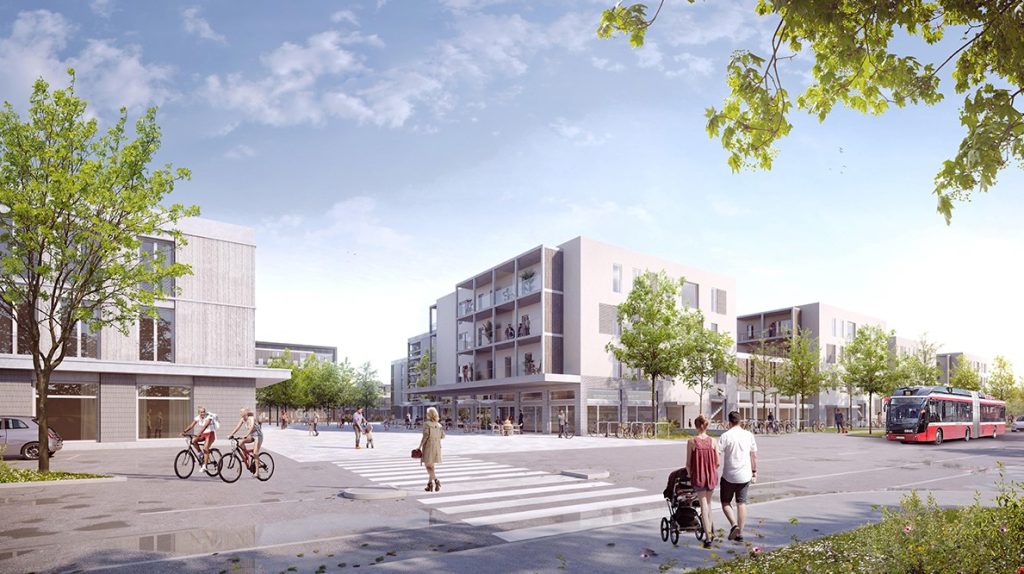
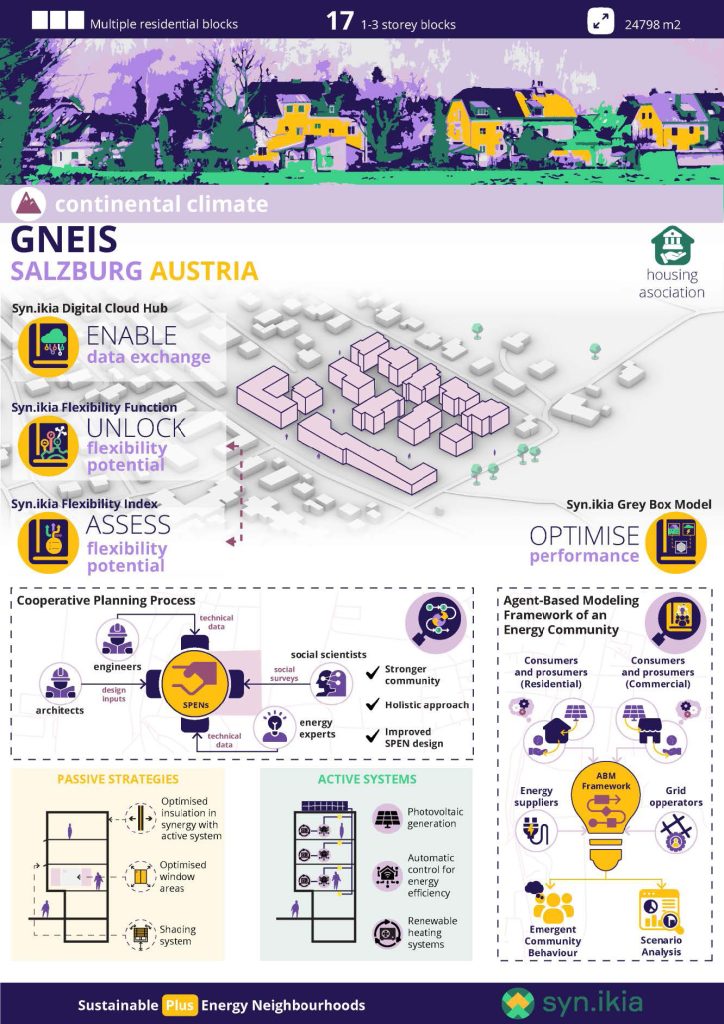
ABUD lead the coordination of a 17-building demonstration site in Salzburg. The demonstration project comprises both new construction and renovation, resulting in 250 social housing dwellings and a kindergarten integrated into an existing neighbourhood. Forty units are assigned via Caritas to support residents with special needs.
Throughout design and implementation, ABUD continuously informed the design process through dynamic energy system simulations, evaluated alternative base-design scenarios, and analysed energy-sharing options, ensuring that the neighbourhood achieves positive energy balance in operation.
The development of a holistic, multidimensional assessment framework took place that is able to recognize the technical capabilities of various district resources, accommodate various markets financial issues, and take into account social sustainability aspects.
ABUD played a key part in developing the indicators, particularly ensuring multidimensionality was maintained to establish a balanced system covering all important objectives. We also played a significant part in creating the social indicators.
SPENs deliver social, economic, and environmental benefits across all pillars of sustainability, extending beyond individual buildings to create broader value for society. Our experts helped BPIE develop and test the Multiple Benefits Tool, assisting with the establishment of calculation methods and basic methodology.
The MBx tool, developed within syn.ikia project, is a step forward in quantifying and monetising the social welfare, micro-economic and environmental benefits of projects, by considering the added values of the SPEN approach.
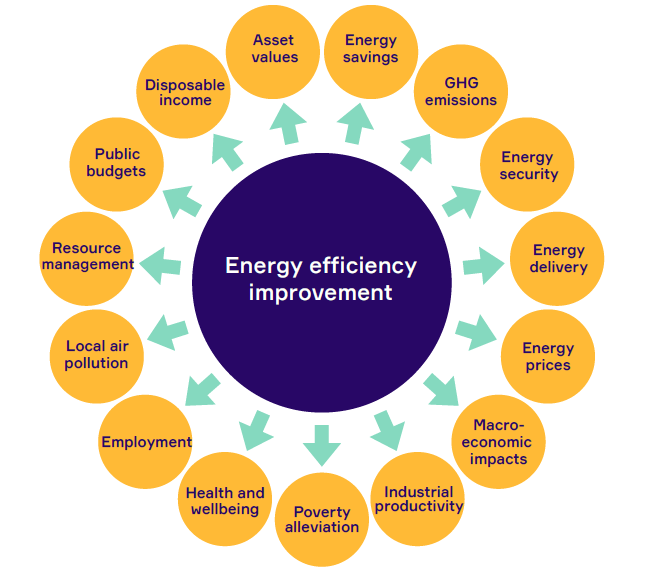
Multiple benefits of energy efficiency on a macro-economic level (IEA)
At the syn.ikia demo locations, the policy landscape was analysed in detail in the following factsheets, outlining existing barriers and tailored policy recommendations regarding
In cooperation with SIR, we played a key role in mapping the Austrian legal environment and assisting our Austrian partner in developing and validating specific regulatory proposals.
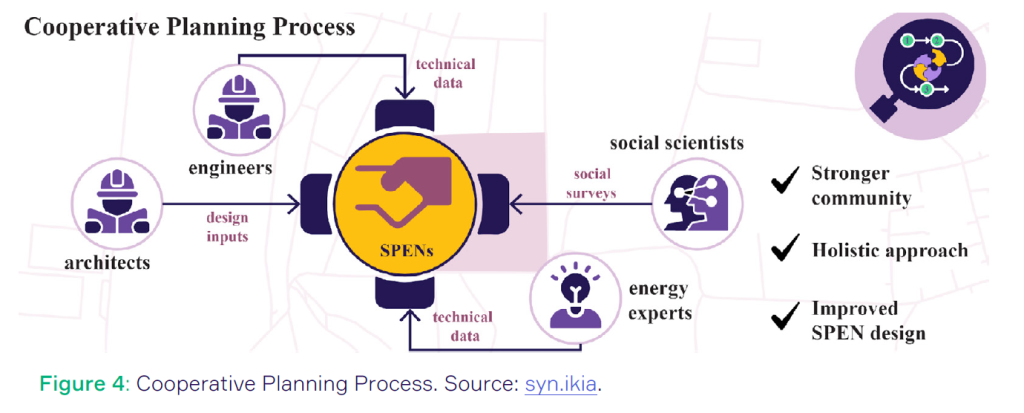
In the case of Gnice demo site in Salzburg, Austria, a sociologist and the “Wohnservice” office of the city of Salzburg initiated a transparent cooperative planning process with involvement of stakeholders from the neighbourhood. We supported this collaborative process on site.
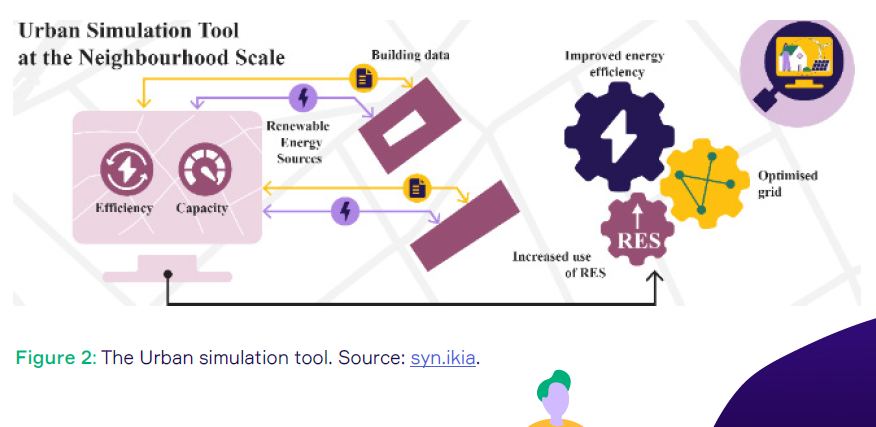
The Urban Simulation Tool is a piece of software that can analyse and optimise the share of renewable energy among a set of buildings being part of an Energy Community in a SPEN. ABUD assisted IREC in testing the Urban Simulation Tool for energy sharing with continuous iterative feedback, based on the Austrian demo site, for which we provided design support.
The syn.ikia Cloud Hub is a central solution for data management, offering secure data transfer, storage, and a customizable computational environment for processing data from
decentralized energy systems. The Cloud Hub includes a web service for data transfer, data storage, and a customizable computational environment. Based on the Austrian demo, we assisted ENFOR in the integration of the Cloud Hub.
Flexibility functions developed at DTU model the dynamic behaviour of building energy systems to quantify and predict how energy demand can be shifted in response to external signals, enabling effective demand-side management, grid stability, and ancillary services. To assess and communicate this potential at neighbourhood scale, a flexibility index and an urban simulation tool were developed to evaluate flexibility performance under different purposes, climates, and advanced control strategies. ABUD was responsible for integrating this development at the demo site in Salzburg.
Based on the knowledge and experiences gained from the development of the syn.ikia demonstration projects, a guideline for planning and design of Sustainable Plus Energy
Neighbourhoods (SPENs) has been made to facilitate the Integrated Energy Design of Neighbourhood (IEDN) process.
The IEDN guideline is divided into four main planning and design phases with associated tasks described for the IEDN process, as shown in the figure below. The names and content of the four phases may vary between countries and regions, but the methods and principles described are still relevant for different local contexts throughout Europe.
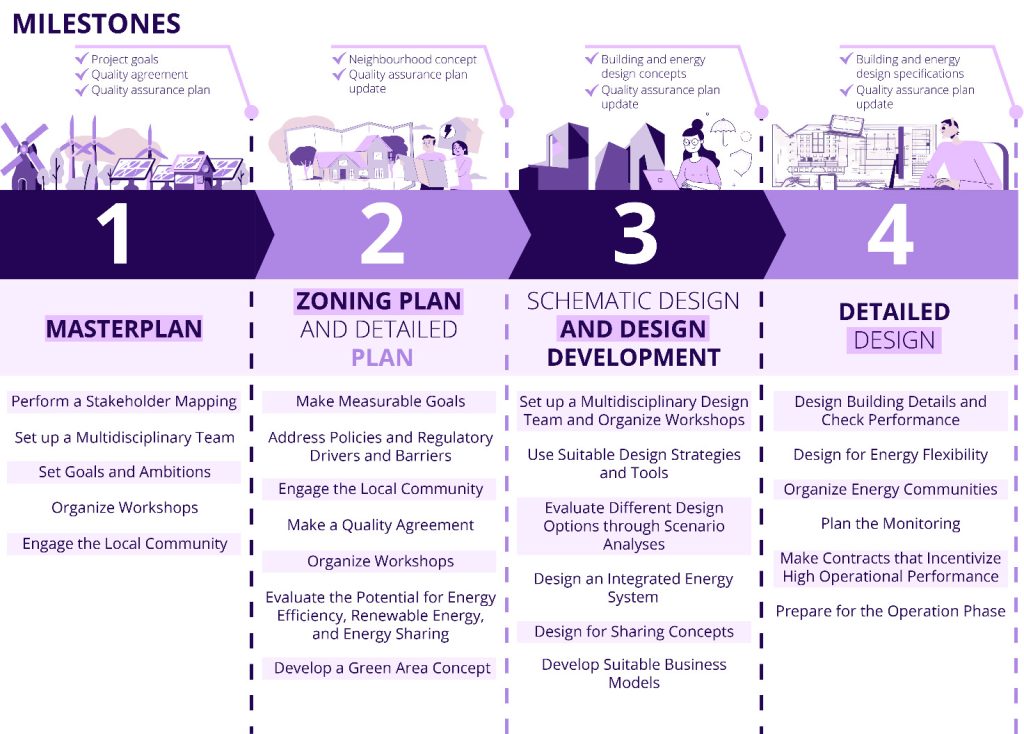
In syn.ikia, multiple design options were developed for each demo project and evaluated using energy simulations and project KPIs. ABUD was responsible for the demo site in Austria – the best-performing designs were further tested under different climate change, user behaviour, and control strategy scenarios to assess robustness and energy flexibility.
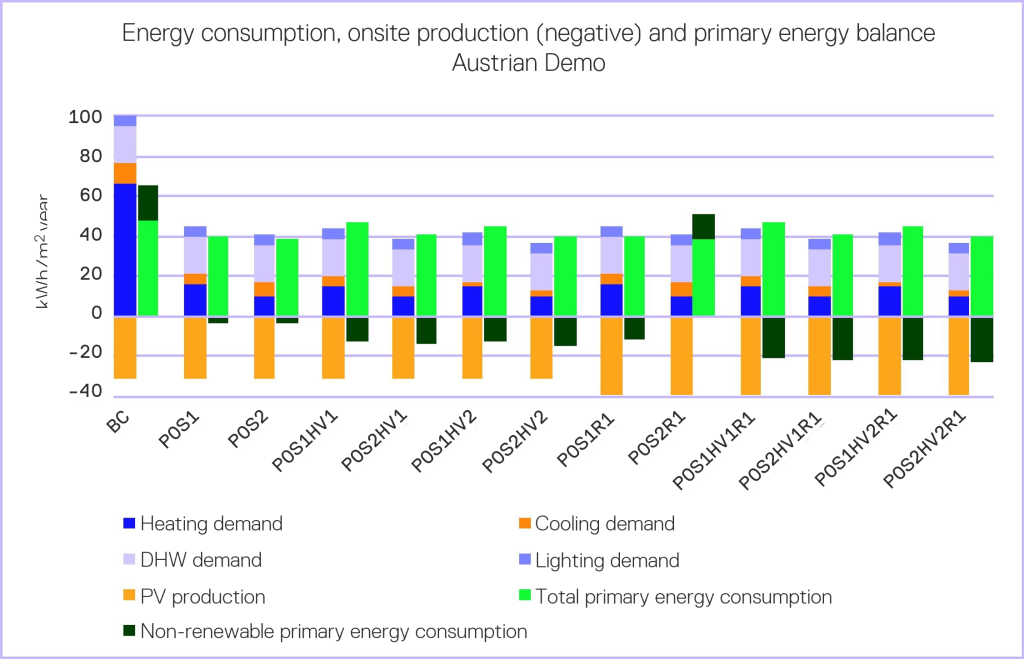
Energy consumption, onsite production (negative) and primary energy balance at the Austrian demo site (syn.ikia)
Designing for energy flexibility enables buildings and neighbourhoods to adapt energy use and generation through demand-side management, storage, and advanced control strategies in response to price, CO₂, and grid signals. Based on this approach, ABUD optimized the Austrian demo using DTU-developed algorithms, integrating mechanical and electrical systems with energy storage devices to enhance flexibility while maintaining occupant comfort.
With the contribution of our experts, different urban simulation tools were reviewed, such as URBANopt, CEA, and UMI, which may be used to model different neighbourhood layouts, and get predictions of energy loads, demands, and renewable energy generation. However, the available tools are not yet able to analyze and optimize energy flows in a large building or within a group of buildings and examine their interaction with the shared electrical grid infrastructure.
The syn.ikia Urban Simulation Tool addresses this gap by co-simulating buildings, renewable systems, and shared electrical grids, enabling energy sharing, flexibility control, and cost evaluation within energy communities.
Browse the project’s innovations, ranging from ICT solutions for flexibility, Context specific solutions, and Prospective solutions for SPEN implementation: